
How to Apply for a U.S. Entry Waiver: Complete Guide for Canadians
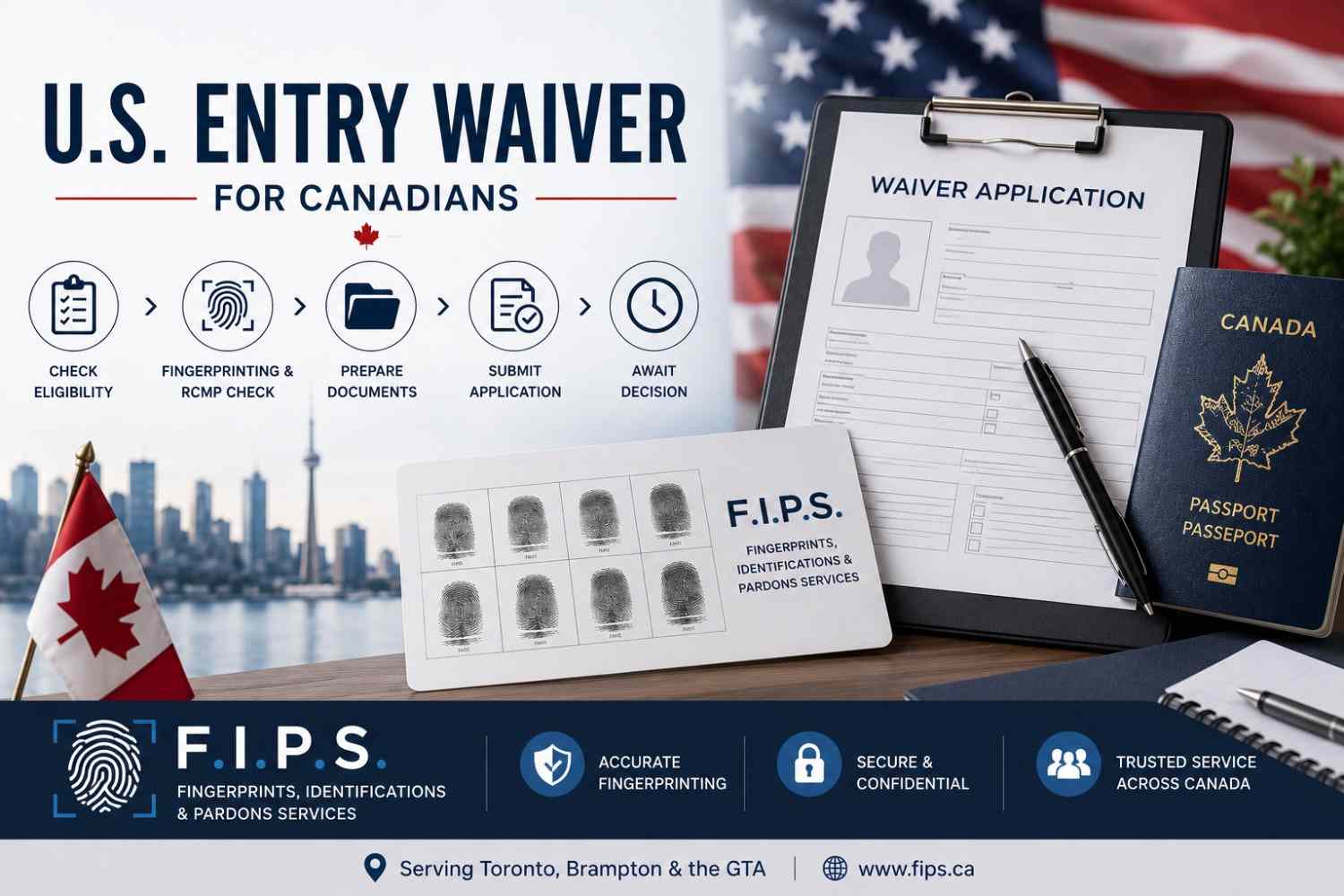
If you are a Canadian citizen with a criminal conviction, previous immigration violation, or another issue that makes you inadmissible to the United States, you may need a U.S. Entry Waiver before travelling across the border.
A U.S. Entry Waiver can provide advance permission for certain inadmissible non-immigrants to enter the United States temporarily. For eligible applicants, Form I-192 (Application for Advance Permission to Enter as a Non-immigrant) is the relevant waiver application
At F.I.P.S. (Fingerprints, Identifications and Pardons Services), we provide RCMP-accredited fingerprinting, criminal record and other pertinent documentation services that can help Canadians complete important supporting requirements for a U.S. Entry Waiver application.
Important: A U.S. Entry Waiver is an immigration matter. F.I.P.S. provides fingerprinting and supporting services, not legal advice.
A U.S. Entry Waiver is permission that may allow an otherwise inadmissible foreign national to enter the United States temporarily as a non-immigrant.
For eligible Canadians, the process commonly involves Form I-192. U.S. Customs and Border Protection (CBP) explains that Form I-192 allows certain inadmissible non-immigrants to request advance permission to enter the United States temporarily.
A waiver does not erase a criminal record or permanently remove inadmissibility. It is permission to enter the United States subject to the terms of the approval.
Who May Need a U.S. Entry Waiver?
You may need a waiver if U.S. authorities determine that you are inadmissible because of circumstances such as:
- Certain criminal convictions
- Certain controlled-substance offences
- Previous immigration violations
- Certain previous U.S. entry problems
- Other grounds of inadmissibility under U.S. immigration law
The specific rules depend on your individual circumstances. CBP recommends seeking legal counsel if you have concerns about whether you are admissible to the United States.
How to Apply for a U.S. Entry Waiver
Step 1: Determine Whether You Are Inadmissible
Before preparing a waiver application, determine why you may be inadmissible to the United States.
Step 2: Identify the Correct Waiver Process
For eligible non-immigrants, Form I-192 is used to request advance permission to enter the United States.
Current CBP guidance encourages eligible waiver applicants to use the Electronic Secured Adjudication Forms Environment (e-SAFE) where applicable. CBP also continues to process certain Form I-192 applications through designated ports of entry.
Because filing procedures can change, applicants should verify the current instructions with CBP before submitting an application.
Step 3: Obtain Your RCMP Criminal Record Documentation
For Canadian applicants with a criminal record or where criminal record verification is required, RCMP documentation can be an important part of the waiver package.
CBP’s current Form I-192 instructions specifically state that Canadians should obtain verification of their Canadian criminal record—or evidence that no record exists—from the RCMP using fingerprints submitted on Form C216C. The RCMP Civil Product and accompanying records must meet the stated age requirements when submitted with Form I-192.
This is where professional fingerprinting services can help.
Step 4: Complete Your Fingerprinting
Your fingerprints must be captured accurately so they can be used for the required criminal record verification.
F.I.P.S. provides professional digital fingerprinting services for Canadians who need fingerprint-based criminal record documentation for applications such as:
- U.S. Entry Waivers
- Immigration
- Citizenship
- Record Suspensions
- Employment
- International travel
F.I.P.S. has locations in Toronto and Brampton and provides fingerprinting services for U.S. Entry Waivers.
Step 5: Gather Supporting Documents
A U.S. Entry Waiver application can require substantial documentation.
Depending on your circumstances, supporting documents may include:
- Proof of Canadian citizenship
- Completed Form I-192
- RCMP criminal record documentation
- Court records
- Records relating to convictions or charges
- Personal statement
- Evidence of rehabilitation
- Employment information
- Other supporting evidence
CBP’s current instructions state that applicants with criminal convictions should provide official court records and a signed personal statement explaining the circumstances of arrests, convictions, and sentences. Evidence of rehabilitation or reformation of character may also be submitted.
Step 6: Submit the Application
The appropriate filing method depends on your circumstances and current CBP procedures.
CBP currently states that eligible waiver applicants can use e-SAFE and that certain applications can be filed with CBP in advance of intended travel through designated filing locations. CBP also states that its designated Canadian preclearance offices no longer accept Form I-192 applications for processing.
Always verify the current filing instructions before travelling to a submission location.
Step 7: Wait for a Decision
Processing times can vary significantly.
CBP currently advises applicants to allow at least 180 days before making a status inquiry, and states that a full review can take six months or longer.
For this reason, Canadians who know they will need a waiver should begin the process well before planned U.S. travel.
What Happens After a U.S. Entry Waiver Is Approved?
If your waiver is approved, follow the conditions and validity period specified by U.S. authorities.
An approved waiver does not guarantee admission on every future visit. You must still meet applicable U.S. entry requirements, and CBP officers make admissibility determinations when travellers seek admission.
Does a Canadian Record Suspension Remove the Need for a U.S. Entry Waiver?
No.
A Canadian Record Suspension and U.S. immigration admissibility are separate legal matters. Receiving a Canadian Record Suspension does not mean that U.S. authorities will consider you admissible.
If you have a criminal history and want to travel to the United States, please contact us.
Why Is Fingerprinting Important for a U.S. Entry Waiver?
Fingerprinting provides reliable biometric identification and allows the RCMP to conduct a fingerprint-based criminal record verification.
For Canadians applying for a U.S. Entry Waiver, CBP specifically identifies RCMP criminal record verification using fingerprints as part of the documentation requirements.
Accurate fingerprinting can help prevent avoidable problems caused by poor-quality impressions or incorrect identification information.
Why Choose F.I.P.S.?
F.I.P.S. provides professional fingerprinting and identification services for Canadians who require documentation for U.S. Entry Waivers and other official applications.
Our services include:
- RCMP Digital Fingerprinting
- U.S. Entry Waiver Fingerprinting
- RCMP Certified Criminal Record Checks
- Criminal Record Verification
- Immigration Fingerprinting
- Citizenship Fingerprinting
- Record Suspension Fingerprinting
- International Fingerprinting
- Identity Verification
We serve clients throughout Toronto, Brampton, Mississauga, North York, Scarborough, Vaughan, Markham, Richmond Hill, and the GTA.
Frequently Asked Questions (FAQ)
A U.S. Entry Waiver is advance permission that may allow certain inadmissible non-immigrants to enter the United States temporarily. Eligible applicants commonly use Form I-192.
Eligible Canadians generally need to determine their inadmissibility, prepare Form I-192 and supporting documentation, obtain required criminal record and fingerprint documentation, and follow the current CBP filing procedure.
Canadian applicants requiring RCMP criminal record verification generally need fingerprints. CBP specifically requires Canadian applicants to obtain RCMP verification using fingerprints for the Form I-192 process.
Form I-192 is the Application for Advance Permission to Enter as a Non-immigrant. It is used by certain inadmissible non-immigrants to request permission to enter the United States temporarily.
Processing times vary. CBP currently advises applicants to allow at least 180 days before requesting a status update, and some cases may take six months or longer.
You should not assume that a pending waiver allows you to enter the United States. If you are inadmissible, seek appropriate legal advice before attempting to travel.
No. Canadian record suspensions and U.S. admissibility are separate matters. A U.S. immigration professional can assess whether you require a waiver.
Yes. F.I.P.S. provides fingerprinting and criminal record documentation services.
Applying for a U.S. Entry Waiver as a Canadian can be a detailed process, particularly when a criminal record is involved. The key is to understand your inadmissibility, obtain the correct RCMP documentation, complete the required fingerprinting, prepare supporting evidence, and follow the current CBP filing instructions.
F.I.P.S. can assist with the fingerprinting and RCMP criminal record documentation required for your application. If you are planning to apply for a U.S. Entry Waiver, contact F.I.P.S. to learn how our fingerprinting services can support your application.